
Thinking, insights, and News.NYCD team never stop thinking of innovation.

Hardware Product Development Lessons for Beginners
Many clients who approach NYCD-Design for services often ask a similar question:
Beyond product and engineering, how can we quickly understand the full hardware product development process?
How can companies build a risk-control mindset across the entire product lifecycle?
How can product teams develop a stronger philosophy and discipline for hardware development?
...
and so on.
These questions are especially common among founders, product managers, R&D leads, makers, and all entering hardware for 1st time. While product design defines the user experience and product form, the real challenge often lies in what comes next — engineering, manufacturing, and mass production.
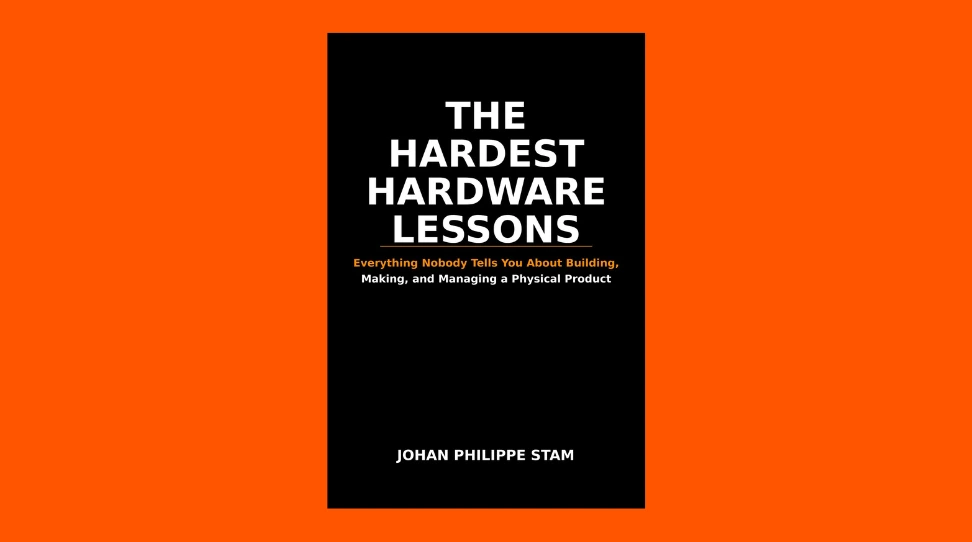
If you want a practical introduction to how hardware products are actually built, one book NYCD-Design team would recommend is The Hardest Hardware Lessons.
You can explore the book here:
https://hansolo42.gumroad.com/l/thehardesthardwarelessons
Unlike many theoretical guides or flashy tutorials, this book explains hardware development through real-world failures, factory realities, and the kinds of mistakes that cost teams months of time and millions in production risk. For teams entering hardware development, it can quickly build a clearer mental model of how the entire system works.
Key Concepts from The Hardest Hardware Lessons
The Hardest Hardware Lessons takes you through every phase of a hardware product's development — from the first bench prototype to mass production at scale — with the specific mistakes named, the financial costs quantified, and the decision frameworks made explicit.
Prototyping — how to turn a hypothesis into a validated concept, why the three prototype streams must run in parallel, and what a DFM handoff should actually contain
Project Set-up — how to write requirements that eliminate ambiguity, how to build a project plan with a real critical path, and why four weeks of planning prevents four months of rework
EVT — how five teams work simultaneously, how interface failures happen and how to prevent them, and what a genuine EVT gate looks like versus a scheduled pass
DVT — how to manage certification without a crisis, when to release to hard tooling and when not to, and how to make the gate decision in financial terms rather than optimistic ones
PVT — what factory readiness actually means, how to run a Pilot Run that produces valid data, and how to hold the final gate when the pressure to pass it is at its highest
Mass Production — yield management, root cause analysis, engineering change discipline, field failure intelligence, customer escalations, recalls, and scaling
Key Hardware Development Lessons from The Hardest Hardware Lessons
At NYCD-Design, our work in product design, engineering, and product definition always includes extensive early-stage risk prediction and mitigation for our clients. From the earliest concept stage, we evaluate potential risks across structure, electronics, manufacturing, and supply chain - helping teams avoid costly surprises later in development.
However, The Hardest Hardware Lessons goes far beyond basic methodology. The book is built on real-world failure cases that reveal the hidden traps inside hardware development. In many situations, avoiding failure is the fastest path to success. Learning from mistakes that others have already paid for can save enormous time, cost, and engineering effort.
Some of the key lessons explored in the book include:
How hardware moves from prototype to mass production -Understanding the real purpose of EVT, DVT, and PVT stages.
Why many hardware startups fail during manufacturing - Hidden risks in tooling decisions, PCB design, and validation gaps.
How to evaluate factories and manufacturing partners - What experienced operators look for that first-time teams often miss.
How supply chains break - and how to design resilience - Managing shortages, single-source risk, and production continuity.
How engineering decisions impact cost and reliability at scale - Why late-stage problems become exponentially more expensive.
How hardware products evolve after launch - Cost reduction, product iteration, sustaining engineering, and lifecycle management.
These lessons reflect the reality that hardware development is NEVER just a design process, it is a coordination system involving engineering, manufacturing, supply chains, and quality control.
Why This Matters for Product Development
At NYCD-Design, we believe industrial design is only the starting point of a successful hardware product.
Great products are created when design, engineering, and manufacturing are aligned early in the process. Understanding how these systems interact helps companies avoid common pitfalls and dramatically improve development efficiency.
For teams exploring hardware development, this book offers a practical perspective that complements the design process and provides a deeper understanding of the ecosystem behind physical products.
You can explore the book here:
https://hansolo42.gumroad.com/l/thehardesthardwarelessons
-
Feb-04-2026
Why Police Officers Hang Radios on Left Shoulder: Life-Saving Design
This webpage explores an intriguing question: why do most police officers prefer to hang walkie - talkies on the left shoulder? Discover how this small design choice could save lives in critical moments. In the realm of product development and innovation, even such details matter. It shows how design can enhance user value and safety, making it a must - read for those interested in practical design applications. -
Apr-19-2025
Why Choose a Professional Design Firm to help Build Your own Structure R&D Team?
Tap into China's industrial design expertise to boost your structural R&D capabilities. Discover how experienced Chinese design firms help international teams transition from conceptual tools like Rhino to precision platforms like SolidWorks and Creo, ensuring manufacturing-ready results. -
Mar-09-2025
How Do Firefighting Radios Differ From Consumer Models in Industrial Design Details?
Discover how industrial design elevates firefighting radios through material selection, audio engineering, and rugged functionality. Learn why product development choices in telecommunications tools save lives.